NEST Research

NEST
the Neurodevelopmental Ecological Screening Tool is a web-based platform originally created for use with children ages 3-5 in low-resource settings in the United States.
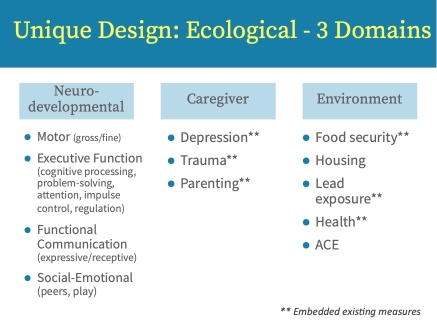
The exclusive NEST algorithm looks at the relationships across three domains – child neurodevelopmental functioning, caregiver mental health and parenting style, and environmental influences – to identify a child’s true level of risk based on their family and social ecology.
Designed to function as a scientifically grounded, clinical decision-making tool, NEST generates evidenced-based recommendations in real time. This allows for brief interventions and, when appropriate, referrals that specially target the identified risk factors.
As a validated commercial measurement tool in the U.S., it enables professional and paraprofessional staff alike to quickly identify young children’s level of developmental risk, substantially increasing the human resource network available to effectively screen children and families in low-resource settings.
Why NEST?
NEST offers service providers at any level, and caregivers of children in low-resource environments a valid, reliable, and practical screening tool that assesses how a child is developing and identifies practical ways to minimize risk factors and build resilience for children faced with adversity.

When children are exposed to six or more risk factors, the chance that they will have a developmental delay is 90 percent (Shonkoff, 2008).
The Purpose of NEST
To offer service providers at any level, and caregivers of children in low-resource environments a valid, reliable, and practical screening tool that assesses how a child is developing and identifies practical ways to minimize risk factors and build resilience for children faced with adversity.

For developmental screening to be effective it should begin early in a child’s life; be repeated throughout early childhood; and use reliable, valid screening tools appropriate to the age, culture, and language of the child. This can be a challenge, since very few developmental screening tools are developed or tested with linguistically or culturally diverse samples of children.
Source: Moodie et al (2014) Early childhood developmental screening: A compendium of measures for children ages birth to five. Administration for Children and Families.
NEST's Unique Ecological Design

- Developed with a diverse sample
- Ecological framework
- Assesses risk/protective factors
- Online and user friendly
- Designed for non-clinical professionals
- Actionable recommendations in real-time
The Theory Behind NEST

Development Timeline
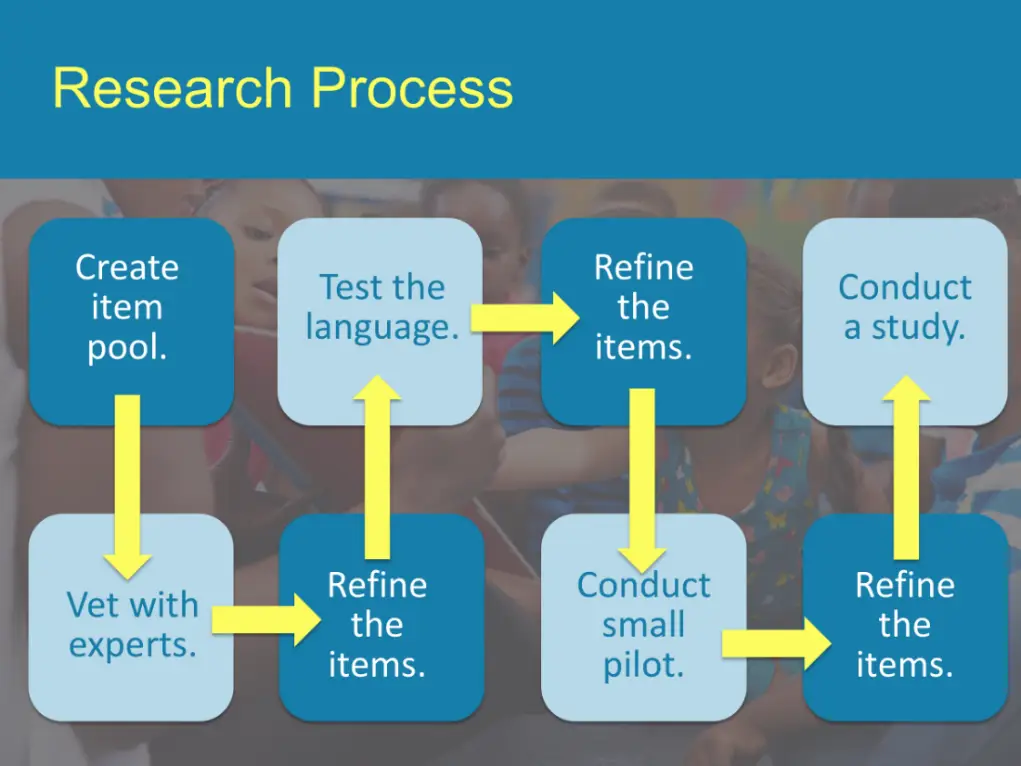
We completed a Phase I pilot study in Massachusetts based shelters to assess the feasibility of administering such a tool in this setting. Case workers were trained to administer NEST to parents of children in the program. Both groups provided feedback on the questions and ease of use of the tool, and adaptations were made based on their input.
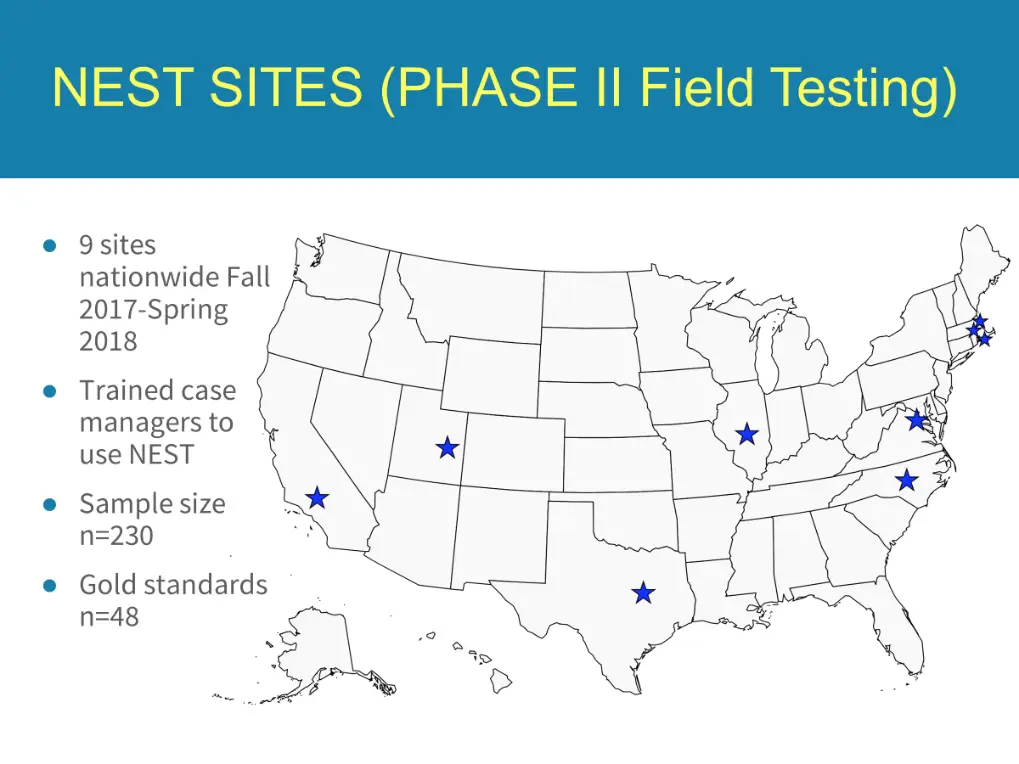
We launched Phase II, a national validation study in 9 programs across 5 states in the United States representing the east and west coasts, south, and Midwest regions, all of whom served a racially and culturally diverse group of children living in poverty and experiencing early life adversities including homelessness.
We completed data analysis and finalized the tool.
Since completion of the project, we disseminated results of NEST to a wide audience and prepared the tool for release.
What is NEST?
Neurodevelopmental
NEST screens children across developmental domains. Questions target areas known to predict adaptive functioning including how a child thinks, solves problems, communicates, moves, interacts with others, and manages emotions.
Ecological
NEST screens for caregiver wellbeing and environmental conditions. Questions target areas known to support healthy child development including caregiver mental health and parenting skills, and factors impacting the quality and stability of the living environment.
Screening Tool
NEST generates actionable recommendations in real time to support parents and providers in constructing a plan to best support a child’s development. Over the course of 20 minutes, service providers guide parents through multiple-choice questions in an easy-to-use online format. Based on the responses, results will suggest ways to build on identified strengths and address potential areas of risk to best support the child’s development.

NEST — Early Childhood
The Story of NEST
NEST combines decades of research in child development with the latest advances in computerized clinical decision support systems, providing an avenue to universal screening. NEST is grounded in Bronfenbrenner’s ecological systems theory which posits that an individual’s development is influenced by a series of interconnected environmental systems, ranging from the immediate surroundings (e.g., family) to broad societal structures (e.g., culture).
NEST – or the Neurodevelopmental Ecological Screening Tool- is a web-based platform originally created for use with children ages 3-5 in low-resource settings in the United States. The exclusive NEST algorithm looks at the relationships across three domains – child neurodevelopmental functioning, caregiver mental health and parenting style, and environmental influences – to identify a child’s true level of risk based on their family and social ecology. Designed to function as a scientifically grounded, clinical decision-making tool, NEST generates evidenced-based recommendations in real time. This allows for brief interventions and, when appropriate, referrals that specially target the identified risk factors. As a validated commercial measurement tool in the U.S., it enables professional and paraprofessional staff alike to quickly identify young children’s level of developmental risk, substantially increasing the human resource network available to effectively screen children and families in low-resource settings.
“For developmental screening to be effective it should begin early in a child’s life; be repeated throughout early childhood; and use reliable, valid screening tools appropriate to the age, culture, and language of the child.”
NEST’s Unique Ecological Design
NEST Publications: Annotated Bibliography
Several papers have been published in which we chronicle the development of NEST, its validation, and present data on caregiver factors and their association with child development learned from the study. Taken together, these papers support the need for valid and reliable screening of children to identify risk, and guide front line service providers, caregivers, and policy makers, on how to improve child serving systems of care.
The Story of NEST
DeCandia, C.J., Unick, J., Volk, K., Donegan, L.R. (2020). Developing a Screening Tool for Young Children Using and Ecological Framework. Infants and Young Children. v33 n4 p237-258. DOI: 10.1097/iyc.0000000000000173; https://journals.lww.com/iycjournal/Fulltext/2020/10000/Developing_a_Screening_Tool_for_You ng_Children.2.aspx
Young children from impoverished backgrounds experience high levels of family and environmental stress, adversely impacting developmental functioning. Early identification provides a pathway to solutions, but many children are never evaluated. In addition, the child-serving workforce lacks resources and expertise to use traditional measures. Furthermore, existing =measures do not ac- count for the substantial influence of a child’s ecology. To bridge these gaps, we developed the Neurodevelopmental Ecological Screening Tool (NEST) and conducted a pilot study (n=60) to test its feasibility for use with caregivers of children 3–5 years =of age in low-resource settings. We developed an item pool across 3 domains (child, caregiver, and environment), vetted it with experts, and conducted cognitive interviewing with parents (n=15) and case managers (n=10). Simultaneously, we built an online, user-friendly delivery platform. We used a one-parameter Item Response Model and a Rasch-based Rating Scale Model and fit confirmatory factor analytical models to test for unidimensional and construct validity. The results support the feasibility of screening children from low socioeconomic status populations within low-resource settings using an ecological perspective and support the work of child-serving paraprofessionals in identifying and addressing risks in the lives of young children.
DeCandia, C.J., Unick, J., Volk, K, (2021). Validating the Neurodevelopmental Domain of NEST: An ecological screener for use with 3 to 5 year old children impacted by poverty and homelessness. Journal of Psychoeducational Assessment. https://doi.org/10.1177/07342829211005575; https://journals.sagepub.com/doi/pdf/10.1177/07342829211005575?casa_token=I0Ynlr2YEh8AAA AA:7gUAbqKzZqkY-6pbAqKEyl-Mg1pYDKYSyz4lWWznnqtNy8vtZ87qoDdA- Cm8xfQguwSmEOFJOPh_
This paper describes the validation of the Neurodevelopmental domain of NEST, a tool which identifies a child’s level of risk for developmental challenges as influenced by parental and environmental factors. Data was collected from a nationwide sample of caregivers of children ages 3-5 (n=231) living in poverty and experiencing homelessness. Results indicate that NEST validly and reliably identifies a child’s level of developmental risk as influenced by the context of their lives. The child’s Neurodevelopmental score represents a single overarching domain with some variance attributable to distinct developmental constructs. The combination of psychometrically valid screening and clinical judgment makes NEST a valid and reliable tool with clinical and practice significance.
Volk, K., DeCandia, C.J., Unick, J., (2023). The Full Picture: Incorporating Ecological Factors When Conducting Developmental Screening with Young Children Experiencing Homelessness. Child Indicators Research 16(1), 87-108
https://link.springer.com/article/10.1007/s12187-022-09978-6
Conducting a neurodevelopmental screening without considering ecological factors is insufficient and may underestimate the actual risk to development for children living in poverty. This article describes ecological risk factors among a nationwide sample (n=231) of young children experiencing homelessness. Researchers examined rates of health care access and continuity, food insecurity, lead exposure, ACEs, and access to safe places to play using a new ecological screening tool developed for the population. Children in the sample experienced high rates of food insecurity, faced significant challenges to health care access, and significant exposure to adverse childhood events. Children experiencing homelessness and poverty experience more barriers to health care access and significantly more food insecurity and hunger. A third of caregivers reported that their child had some exposure to lead, primary due to substandard housing. And the majority were enduring prolonged periods of homelessness with over half (56%) being between 1-6 months. Findings are discussed within a social determinants of health perspective. For children already facing socioeconomic disadvantage, routine, ecologically-oriented, developmental screening can help identify and thwart developmental challenges during early childhood, possibly preventing myriad health problems from emerging later in life. This information is vital to helping the child thrive and is also essential to forming sound public policy in which to support their wellbeing.
DeCandia, C.J., Herbers, J., Volk, Unick, J., Volk, K.T. (2023). Parent Characteristics Associated with Neurodevelopmental Competence for Young Children Experiencing Family Homelessness. Journal of Family and Children Studies, 1-13. https://link.springer.com/article/10.1007/s10826-023-02566-4
Children rely on their parents or other primary caregivers to develop the neurodevelopmental underpinnings of resilience – social and emotional skills and neurocognitive executive functions. Adversity compounds a child’s risk for poor developmental outcomes; the health and wellbeing of parents may add to, or buffer children from, potential impacts. With a sample of 231 children ages 3-5 and their parents experiencing homelessness, we screened parents for depression, post-traumatic stress symptom (PTS), and overreactive parenting and assessed how these factors were associated with children’s neurodevelopment. We used confirmatory factor and structural equation modelling to devise a latent variable of parental distress to develop a parent-child model. Results are displayed as standardized coefficients to increase the interpretability of the latent variables by rendering them in standard deviation units. Key findings indicate significant associations between parental mental health and multiple domains of child development. Results indicate that a one unit increase in parent distress was negatively associated with child neurodevelopmental functioning equivalent to several months delay. Within the parent functioning construct, depression and PTS showed strong loadings, while overreactive parenting was moderately associated with the latent construct. This represents a substantial difference in the real lives of parents and children experiencing homelessness. Implications for practice and policy and the need for two-generational and family-centered approaches Family- Centered Care for families experiencing housing instability are discussed.
DeCandia, C.J., Volk, K.T., Unick, J. (2022). Evolving Our Understanding: Housing Instability as an ACE for Young Children. Adversity and Resilience Science. Journal of Research and Practice. 3(4), 365-380. https://link.springer.com/article/10.1007/s42844-022-00080-y
Purpose: We investigated the impact of ACEs in a sample of 231 children ages 3-5 living in poverty and experiencing homeless as related to the wellbeing of their caregivers and sociodemographic factors including housing instability was accounted for, something not routinely done.
Method: Data was collected using the newly validated Neurodevelopmental Ecological Screening Tool (NEST), across three domains (neurodevelopmental, caregiver, and environment) encompassing 13 neurodevelopmental constructs. We used Structural Equation Modelling (SEM) to test the association between domains and ACE scores and assessed the impact on neurodevelopmental constructs.
Results: Fifty-five percent of the sample had a high child ACE scores (> 3) which was associated with lower attention, social skills , emotional regulation. ACEs were strongly associated with higher levels of caregiver distress (p < .001), which was also associated with lower levels of child neurodevelopmental functioning (p = .005). For each unit increase in housing instability there was an increase of half of an ACE score (.49 ACE at p = .002); 4 or more moves was associated with the worst neurodevelopmental outcomes (53% of the sample). Conclusion: We must use both a developmental lens and ecological perspective to understand how early adversity impacts children, at what age, in what context. We are likely underestimating the impact of ACE on child development if we do not inquire about housing status. Housing disruption and caregiver wellbeing both need to be included in any investigation of ACE during childhood and embedded into the policies and practices of agencies and systems serving at-risk families.
Herbers, J. E., DeCandia, C. J., Volk, K. T., & Unick, G. J. (2023). Profiles and predictors of neurodevelopmental functioning among young children experiencing family homelessness. Early Childhood Research Quarterly, 65, 407-416. https://www.sciencedirect.com/science/article/pii/S0885200623000984?casa_token=8xWsBhqUpHgAAAAA:PyBNvWcgL3OHj0guhJHL2RdYgtselnc-uxP45KpNbkTjN40yrdE1crhLP-nJJQj0LDw_8GZzcw
In the context of family homelessness, children experience acute adversities related to loss of housing and residential mobility compounded with more chronic, poverty-related adversities and stressors.
Among children in families experiencing homelessness, variability in experiences and outcomes warrant person-centered approaches to better delineate patterns of risk and resilience. Using latent profile analysis as a person-centered approach, we identified five distinct profiles of neurodevelopmental functioning within a sample of 231 children (ages 3-5 years old) staying in emergency homeless shelters with their families. Latent profiles were informed by indicators from parent-reported items for ten different domains of neurodevelopmental functioning. We examined whether demographic and ecological factors including age, ethnicity, adverse childhood experiences, parent mental health, and overreactive parenting would predict profile membership. Overall, half of the children in the sample demonstrated a profile of resilient functioning across developmental domains. Profiles of maladaptive functioning differed in areas of strength and challenge, with a small percentage of children showing poor functioning across all domains. Children whose parents had more mental health problems or overreactive parenting were significantly more likely to show profiles of poor functioning than to show resilient functioning.
Coming Soon
NEST for other Age Groups
NEST-early childhood will be complemented by future tools to address the needs of children of other age groups. NEST-Infants and Toddlers is proposed to meet the needs of the very young children ages 0-2 years living in poverty, homelessness, or affected by early adversity. We hope to expand NEST to meet the needs for screening school age children, and for other language groups, in the United States in the coming years.
Global Adaptation
NEST-USA is a model of an mHealth platform that is well suited for adaptation and implementation in Low and Middle Income Countries. The promise of NEST adapted for open access global use is beginning with Perú, in partnership with the University of Maryland School f Socia Work, Health Bridges International, and the Universidad Católica de Santa Maria in Arequipa, Peru. This global effort began in 2019 and is currently working on a pilot project to adapt the tool for the Peruvian context. NEST-Peru We aim to adapt the original NEST framework to the Peruvian context by 1) building an mHealth platform for the screening of developmental and mental health risk in children ages 3-5 in the Peruvian health system; and 2) developing a brief intervention recommendation algorithm. Drawing on several models of community engagement and developmental ecological theory, U.S. and Peruvian providers and researchers are working together to ensure that no young child, no matter where they are, will miss an opportunity for early identification and intervention.